November 13, 2026 · 13 min read · Pineflows team
How to Day Trade Without 25K: Legal Paths in 2026

“Just switch to a cash account” is incomplete advice. A cash account can solve the account-rule problem while leaving you unable to fund the next signal. And a headline about the end of pattern-day-trader restrictions doesn't tell you which controls your broker has implemented.
The practical answer to how to day trade without 25k starts with a dated account check, followed by a settled-cash ledger. Choose an account your broker permits, calculate how much trading your available capital supports, and reject any strategy that needs more buying power than you can safely use.
Table of Contents
- Legal Account Paths Under $25K Compared
- Check Your Broker's Transition Before You Trade
- Cash Account Settlement Limits Your Trade Count
- Margin Leverage Math and Where It Breaks
- Options and ETFs When Capital Is Tight
- Prop Firm Evaluations as Capital Route
- Low-Frequency Routine and Go-Live Checks
Legal Account Paths Under $25K Compared
The familiar threshold governs a particular margin-account classification, not day trading in general. Under the legacy framework, Investor.gov's pattern-day-trader explanation describes four or more day trades within five business days, representing more than 6% of total trades in that period, as the general trigger for a $25,000 equity requirement.
That distinction matters when choosing an account. You're selecting a funding and risk-control structure, not buying permission to trade profitably.
| Path | Capital needed | Main constraint | Best fit |
|---|---|---|---|
| Cash account, settled funds only | Deposited cash sufficient for the purchase | Sale proceeds unavailable for unrestricted reuse until settlement | Traders who can pace entries around available cash |
| Margin account, new intraday framework | Account equity meeting the broker's intraday requirements | Intraday exposure limits and deficit rules | Traders whose broker confirms implementation |
| Margin account, legacy PDT controls | Equity meeting the legacy minimum once classified | Day-trade counting and account restrictions | Traders prepared to keep same-day round trips infrequent |
| Defined-risk options | Premium for a purchased option | The entire premium can be lost | Traders who need a defined contractual loss |
| Liquid ETF shares | Purchase price of the shares | Price movement against the position | Traders seeking straightforward directional exposure |
| Prop firm evaluation | The firm's stated evaluation fee | Firm-set drawdown limits and profit targets | Traders testing an established strategy against external rules |
Separate the account from the instrument
Options and ETFs aren't account-rule exemptions. They're instruments held inside an account, so choosing them doesn't automatically remove settlement requirements or margin restrictions. Likewise, a prop evaluation is a contractual arrangement with a firm, not another retail brokerage account.
A cash account offers the clearest funding boundary: you purchase positions with your own money. Margin offers more flexibility but adds obligations that can change while a position remains open. Neither structure makes a weak entry signal better.
Don't move to an unfamiliar jurisdiction merely because someone advertises fewer restrictions. You still need to understand the broker's legal entity, custody arrangements, withdrawal terms, permitted customers, and dispute process.
Decision rule: Choose the path your broker confirms and your capital can support. Treat an unanswered account-rule question as an unknown, not permission.
Broker policies can be stricter than the regulatory baseline. Before placing an order, make sure your account's actual permissions match the path you selected.
Check Your Broker's Transition Before You Trade
According to FINRA's rule-modernization update, the new intraday-margin standards remove the PDT designation, day-trade counting, and minimum-equity requirement effective June 4, 2026, while brokers may phase implementation in through October 20, 2027.
The regulatory effective date isn't your broker's implementation date. A firm may need to change its risk systems, customer disclosures, account displays, and order controls before your account operates under the replacement framework.
Use this checklist when checking your account.
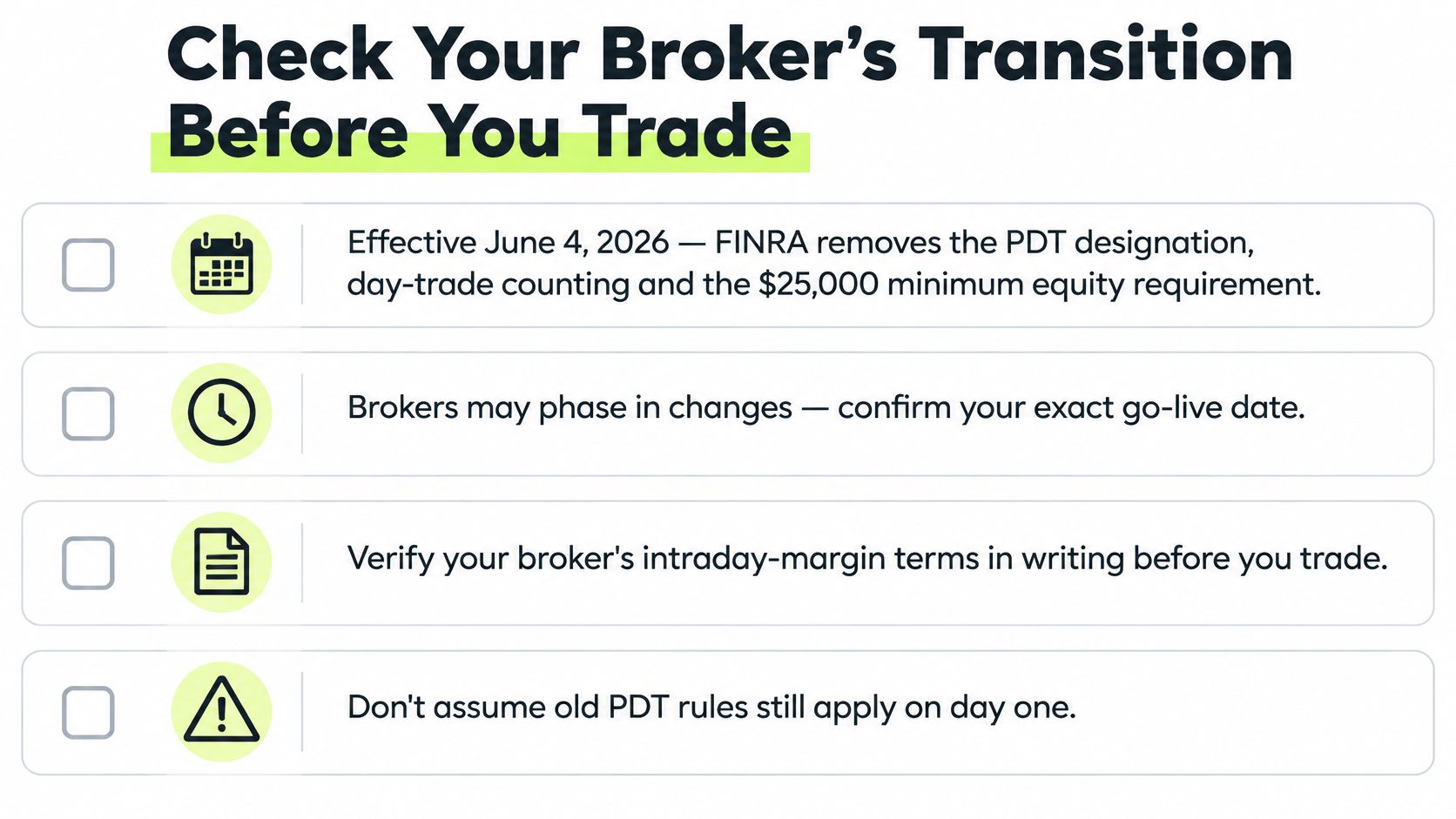
Confirm the account type. Open your account settings and establish whether you have cash or margin permissions. Don't infer this from the app's marketing name or an available-balance display.
Request the implementation status. Ask support whether your specific account has moved to the new intraday framework and request its implementation date. Save the written response rather than relying on a general announcement.
Find your usable intraday limit. Ask which buying-power figure governs a new order and how open orders affect it. Establish whether the broker can raise requirements for particular securities or volatile conditions.
Get the deficit procedure. Request the deadline for curing an intraday margin deficit and the restrictions that apply while it remains outstanding. Ask whether the broker may liquidate positions before you deposit additional funds.
Inspect legacy indicators. Check whether your account still displays a PDT flag, day-trade counter, or related restriction. If the interface and support response disagree, resolve the discrepancy before trading.
Keep a dated record. Save the answers alongside your account agreement and relevant broker notices. Recheck after any notification about margin methodology or trading permissions.
Resolve uncertainty before sending orders
A support response should identify the rules governing your account, not merely say that day trading is available. Ask for the relevant account disclosure if the answer remains vague.
Handle an account still on legacy controls as subject to those controls until the broker confirms otherwise. The replacement framework changes how firms assess intraday exposure; it doesn't promise unlimited buying power or unrestricted execution.
Cash Account Settlement Limits Your Trade Count
Signal frequency isn't trading capacity. A strategy can generate valid entries while your account lacks settled cash to pay for them.
The SEC-hosted comment on FINRA's intraday-margin proposal highlights the operational distinction between cash-account settlement constraints and margin-account exposure controls. For a conservative cash-account workflow, fund each entry from settled cash rather than assuming sale proceeds can immediately finance another completed round trip.
A hypothetical settled-cash ledger
Consider an illustrative account starting with $10,000 of settled cash. Assume the sale proceeds in this example become available the following business morning, every order fills at the stated price, and transaction costs are excluded.
| Timestamp | Action | Settled cash after |
|---|---|---|
| Day 1, 9:30 | Buy 40 ETF shares at $100, spending $4,000 | $6,000 |
| Day 1, 10:15 | Sell those shares at $102, creating $4,080 of unsettled proceeds | $6,000 |
| Day 1, 10:20 | Attempt a $9,180 purchase; block it because it exceeds settled cash | $6,000 |
| Day 2, 9:30 | Sale proceeds settle | $10,080 |
| Day 2, 10:15 | Buy $9,180 of shares after confirming availability | $900 |
The failed purchase isn't evidence that the strategy needs margin. It shows that the strategy's intended sequence requires more immediately reusable capital than this cash workflow supplies.
In this hypothetical, the account could fund another entry within its remaining settled balance. It couldn't conservatively treat the completed sale as fresh settled buying power that same morning.
A profitable exit can increase account value without immediately increasing the settled cash available for your next round trip.
Build a ledger your execution process can enforce
Record timestamp, instrument, actual fill amount, unsettled proceeds, and settlement availability. Reconcile the ledger with the broker before starting another session, and reserve funds for applicable fees or any cash outlay your exit mechanics require.
Partial fills complicate that ledger. An open order may reserve cash, a replacement order may overlap with a cancellation, and duplicate alerts may request another entry before the first order's status is resolved.
Some brokers permit purchases using unsettled proceeds, but selling the replacement position before payment settles can create a violation. Good-faith and freeriding issues involve different payment circumstances, so don't use those labels interchangeably or assume every questionable order will be rejected.
For the account workflow, use the Robinhood stock-trading guide alongside your broker's own settlement display. Capacity planning comes before execution speed.
Margin Leverage Math and Where It Breaks
A margin account isn't just a cash account with a larger spending limit. You're accepting exposure whose losses can consume the equity supporting your trades.
The diagram below illustrates that relationship.
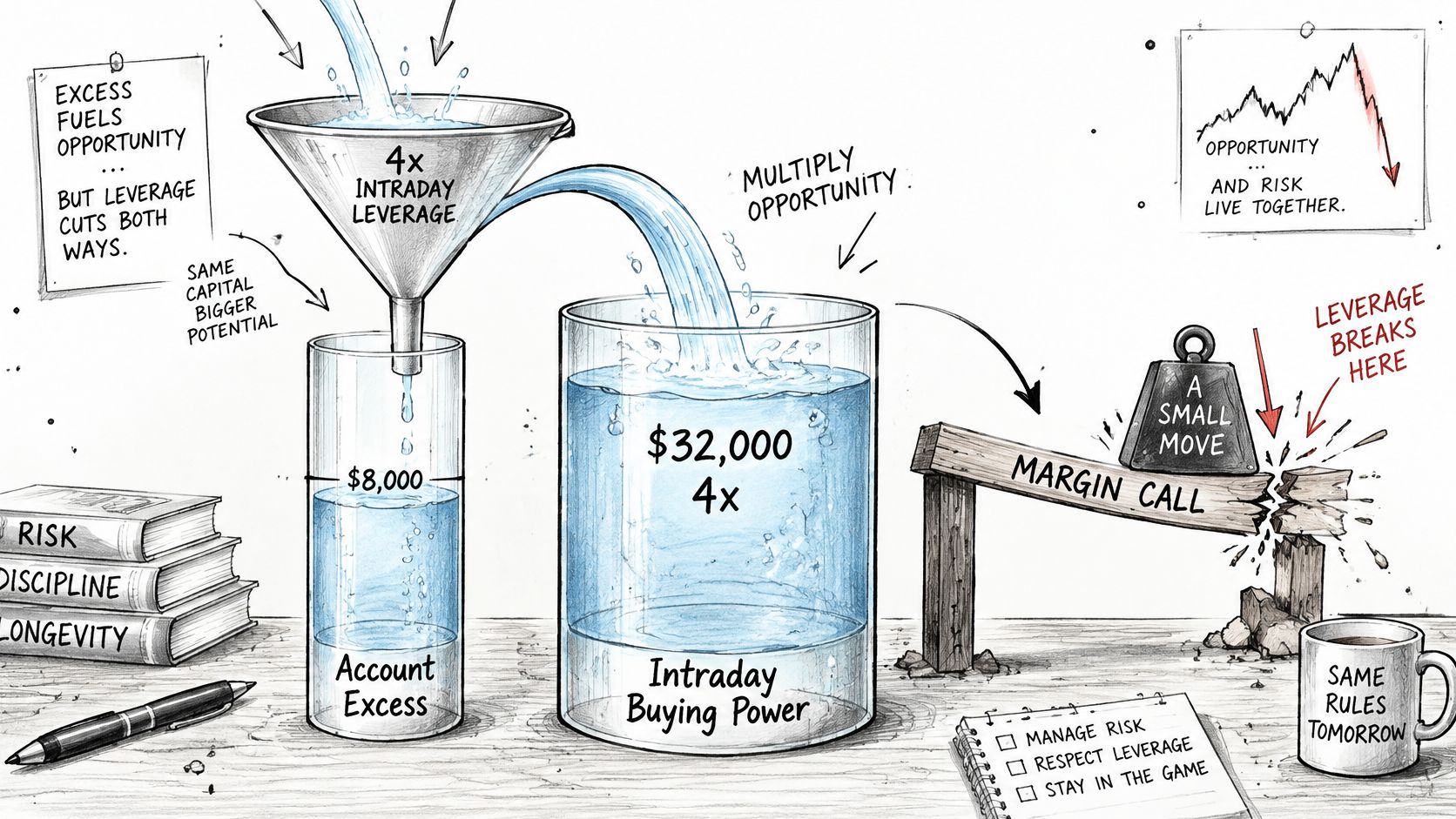
Under the traditional framework, the SEC's day-trading margin guidance describes buying power of up to four times maintenance-margin excess: $8,000 of qualifying excess could theoretically support $32,000 of exposure, where a 10% adverse move produces a $3,200 loss, or 40% of that original excess, before trading costs.
The same guidance generally allows five business days to meet a day-trading margin call, with buying power potentially restricted to two times maintenance-margin excess during that period. Those are legacy-framework mechanics, not a guarantee of the terms your broker applies under its replacement system.
Excess isn't the same as total equity
Maintenance-margin excess is a calculated amount after applicable requirements, not your deposit balance. The example therefore doesn't mean an account containing that amount of cash automatically qualifies for the illustrated buying power.
Nor is maximum permitted size a sensible default position. A broker's limit answers whether an order can pass its controls, not whether the loss fits your strategy.
Before using margin, write down:
- Exposure relative to excess. Measure the proposed position against the capital supporting it, not merely the buying-power number displayed.
- An adverse-execution scenario. Include a gap, poor fill, or delayed exit rather than assuming your stop executes exactly where planned.
- Deficit funding. Identify available funds and the consequences if you can't transfer them in time.
- A liquidation response. Decide what you'll reduce if the broker raises requirements or restricts new entries.
The embedded video provides another format for considering the margin discussion.
Under exposure-based controls, your operational task is to monitor the broker's current requirements while positions remain open. Don't hard-code a historical buying-power multiplier into an automation and assume it remains valid.
Don't increase exposure to imitate a strategy designed for more capital. Reduce position size, reject overlapping entries, or stay in simulation when the strategy can't fit your account's risk budget.
Options and ETFs When Capital Is Tight
| Instrument | Capital per position | Main risk | What to watch |
|---|---|---|---|
| Single long option | Total contract premium plus applicable costs | Premium can be lost entirely | Bid-ask spread, expiry, and exercise handling |
| Vertical spread | Net debit, or collateral for a credit spread | Contractual loss limit requires correct handling of both legs | Approval level, maximum loss, and assignment |
| Liquid ETF shares | Purchase price of the shares | Price movement against the position | Liquidity and cash-account settlement |
| Leveraged ETF | Purchase price of the shares | Daily reset and compounding can produce unexpected holding-period results | Intended holding period and fund methodology |
A cheaper position isn't necessarily a safer position. An option can require less cash than the corresponding share exposure while losing its entire purchase price.
Long options are useful when you need the contractual downside limited to the premium paid, before costs. That protection applies to the option position itself; exercise can create a different position and different funding requirements.
Cheap contracts can be expensive to trade
Small-account traders often focus on the quoted premium and overlook the spread between the bid and ask. If you must cross a wide spread on entry and exit, execution costs can absorb an otherwise plausible edge.
Time decay also matters, particularly near expiry. You can be right about direction and still lose because the move arrives too late or implied volatility falls.
Vertical spreads cap contractual gains and losses, but they require more operational care than purchasing an option alone. Assignment, expiration, and closing only part of a spread can change the exposure you intended to hold.
A buy-call-and-sell-put strategy shouldn't be confused with buying a call. Adding a short put changes the obligations and funding requirements.
For straightforward directional trading, liquid ETF shares keep position accounting easier to inspect. Check the specific fund's holdings and liquidity rather than assuming every ETF behaves like a broad-market fund.
I would avoid ETFs that use borrowed funds for positions intended to last beyond a session unless the strategy explicitly models their daily reset and compounding. Their stated exposure isn't a promise of the same multiple over an extended holding period.
Finally, ask how your broker treats same-day option round trips under your account's controls. Instrument selection doesn't improve the expected return of an unprofitable strategy.
Prop Firm Evaluations as Capital Route
A prop evaluation replaces some personal-capital requirements with a contract and a hard set of trading conditions. The fee buys participation under those terms, not guaranteed access to withdrawable trading capital.
Read the funded-account agreement as carefully as the evaluation advertisement. Establish whether trading occurs in simulation or live markets, who bears losses, and what makes a payout eligible.
Extract the limits. Record the profit target, maximum drawdown, daily loss limit, and any minimum trading-day requirement. Establish whether drawdown follows intraday equity, closed balance, or another calculation.
Check strategy permissions. Confirm the terms for overnight positions, news events, automated entries, and alert-driven execution. A profitable strategy is unusable there if its normal behavior breaches the agreement.
Budget the fee as money at risk. Include any reset, activation, or recurring charges stated in the contract. Don't assume you'll recover them through a payout.
Simulate the exact drawdown calculation. Replay your strategy using the firm's rules, including unrealized losses and trailing thresholds. Test ordinary losing sequences, not just your best backtest period.
Read the payout conditions. Compare the profit split, withdrawal schedule, consistency requirements, and reasons the firm may deny payment. Keep a copy of the terms you accepted.
The Topstep and foreign-exchange evaluation overview offers context for comparing this route, but the actual agreement controls your decision.
Before paying: Your strategy should survive the evaluation's loss rules without changing its logic merely to chase the target.
A prop firm evaluation tests discipline under external constraints. It isn't a reason to take exposure your strategy can't support.
Low-Frequency Routine and Go-Live Checks
Trade count isn't a performance metric. FINRA figures cited in a federal regulatory filing indicate that roughly 75% of PDT-qualified accounts had six or more day trades in five business days, a measure of activity, not profitability.
Your benchmark should be whether you followed a tested process while keeping losses within your planned limits. Trying to compensate for limited capital by generating more trades usually means accepting weaker setups or execution conditions you haven't tested.
Use this workflow before enabling live execution.
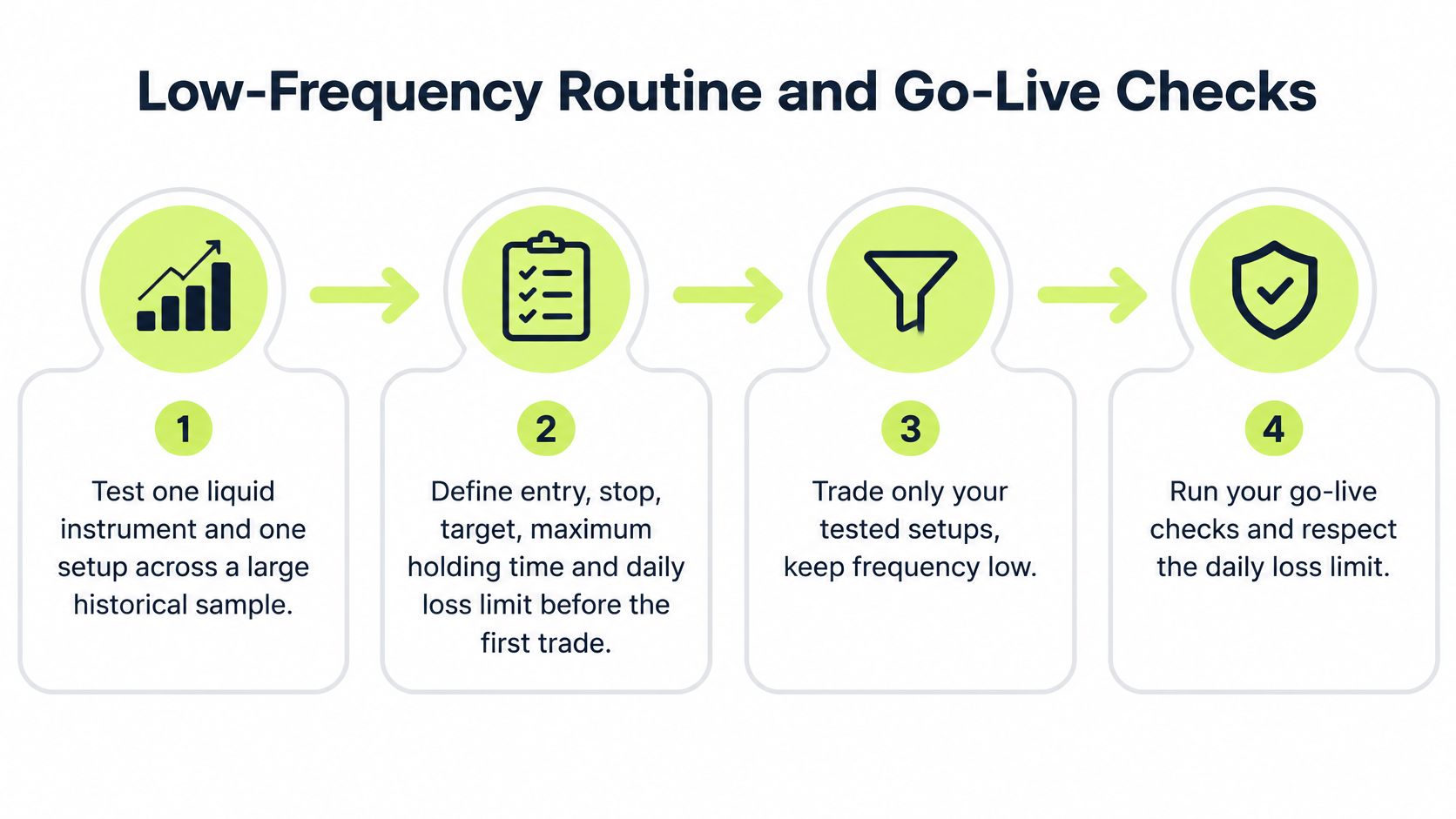
Build the routine before increasing size
Test a specific setup. Start with a liquid instrument and a clearly defined entry condition. Include different volatility conditions and losing periods rather than selecting only the chart segment where the setup looks convincing.
Write the complete trade plan. Define entry, stop, target, maximum holding time, and daily loss limit before placing an order. Record what happens when the entry partially fills or the intended exit can't execute.
Require positive expectancy after execution costs. Include commissions where applicable, spread, slippage, and rejected orders. A backtest based on convenient fills isn't evidence that you can achieve those fills live.
Budget entries from deployable capital. Match the proposed order sequence to your ledger and outstanding commitments. Skip a signal when funding it would require assuming that pending proceeds or cancellations are already available.
Review planned versus actual execution. Record entry and exit differences, order status, slippage, and rule adherence. Separate a strategy loss from an execution failure so you don't change the wrong part of the system.
Set the scaling gate in advance. Choose a fixed forward-trade sample and maximum permitted drawdown before starting. Increase size only after completing that sample within the drawdown limit, with positive results after costs and acceptable rule adherence.
Don't lower the sample requirement after a winning streak. If you change the entry logic, exit rules, or execution assumptions materially, establish a fresh forward test.
Check the live pipeline in order
Confirm your broker's current framework, reconcile available funds with the planned order sequence, and record the maximum planned loss for each position. Start at the smallest size your rules permit, then compare actual execution with the assumptions used in testing.
For TradingView-to-Robinhood automation, Pineflows starts in test mode: we accept and log alerts without sending them to the broker until you switch to live mode. We execute long-only market orders for US equities and ETFs, so options and prop-evaluation workflows aren't part of this execution path.
Review the alert log before activation. A TradingView test alert with blank placeholders doesn't establish that a real strategy fill has been verified.
Keep watching after activation. Alerts can arrive late, twice, or not at all; markets move, and brokers reject orders. Maintain controls that prevent repeated entries, block oversized orders, and preserve valid exits when entries are paused.
Pineflows isn't investment advice, trading involves risk of loss, and a backtest isn't a forecast. Automation executes your rules; it doesn't make them profitable. Run test mode and inspect a real strategy alert before allowing any real order.
Pineflows routes your TradingView strategy alerts into Robinhood orders, with test-mode logs and an explicit switch to live execution. Visit Pineflows to verify your alert workflow before putting your small account's buying power at risk.