November 9, 2026 · 15 min read · Pineflows team
Futures vs Forex Trading: Costs, Leverage and Risk

Global foreign-exchange trading dwarfs any single futures venue because most of it never touches one exchange. The Bank for International Settlements triennial survey measured average global FX turnover at $7.5 trillion per day in April 2022, up 14% from $6.6 trillion per day in April 2019. That total covers spot, outright forwards, FX swaps, options, and other products on a net-net basis. Growth from 2019 to 2022 was the lowest triennial rate in all but two surveys since 2004.
Turnover counts notional value. It is not profit, capital invested, or the depth behind your ticket, and it is not money available to one broker's customers.
Futures vs forex trading still gets framed as a contest of size and opening hours. Those headlines mislead. The same signal can fill at a different price, carry different financing, and leave a different audit record once it hits a standardized contract or a dealer's quote. Judge each market by the execution evidence and the risk budget the strategy needs.
Table of Contents
- Futures and Forex Compared at a Glance
- Fills, Costs and Rollover Compared
- Leverage, Margin and Position Sizing Math
- Which Market Fits Your Situation
- Testing a Strategy Before Either Market Goes Live
- Confirm the Market and Test Mode Before Live Trading
Futures and Forex Compared at a Glance
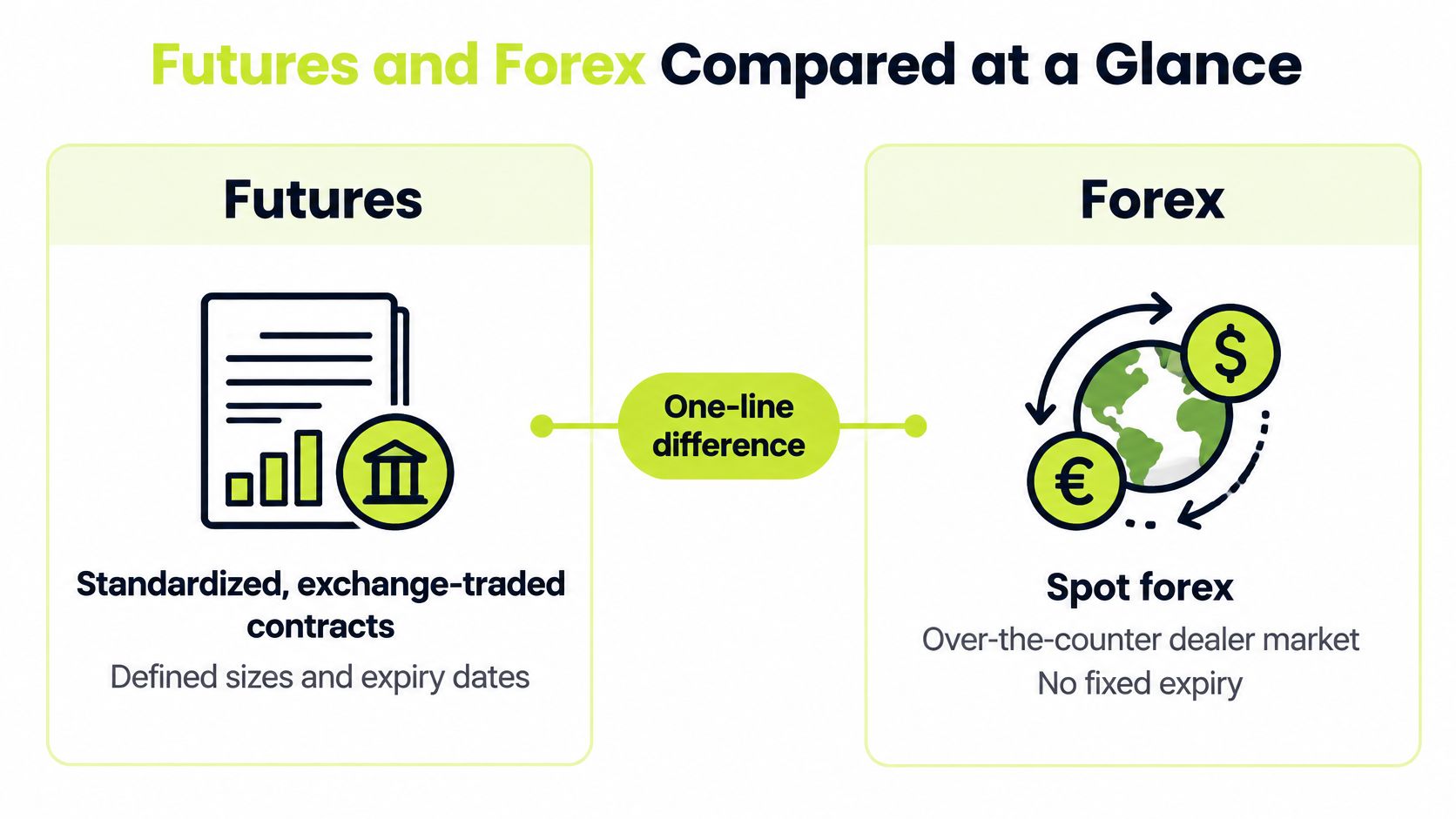
A futures contract is a standardized agreement to buy or sell an underlying at a set date. Spot forex is the relative value of one currency against another, quoted by dealers, and a retail spot position normally has no fixed expiration.
| Factor | Futures | Spot forex |
|---|---|---|
| Market structure | Standardized contracts on a named exchange with central clearing | Over-the-counter dealer and liquidity-provider network, decentralized |
| Contract form | Fixed contract size, tick value and expiration cycle | Negotiated pair quotes, usually no fixed expiry |
| Typical leverage | About 10:1 to 20:1 for typical futures | Up to about 30:1 to 50:1 where regulated; actual caps differ by jurisdiction |
| Collateral | Performance bond, typically about 3% to 12% of contract value | Broker-defined margin percentage |
| Trading hours | Weekday exchange session with a daily maintenance break | 24 hours from Sunday evening to Friday evening, US time |
| Price transparency | Central order book with published volume and open interest | Broker-specific quotes, spreads and execution policies |
| Overnight cost | Roll to next expiry and basis between futures and spot | Rollover or financing charge per night held |
How to read the rows
CME Group describes typical futures initial margin as about 3% to 12% of contract value. That implies notional exposure of roughly 8.3-to-1 through 33.3-to-1 before maintenance margin, variation losses, or contract-specific rules. The same materials indicate typical futures exposure around 10-to-1 to 20-to-1, and regulated retail forex exposure up to about 30-to-1 to 50-to-1 in some jurisdictions. Those ranges are typical, not universal limits. Exchanges, brokers, pairs, volatility, and account type change the collateral.
Futures margin is a performance bond, collateral posted so the clearing house can cover losses. It is not a down payment and not a conventional loan. Forex margin is a percentage the broker sets, and the broker also sets when a position is closed out.
Each row has an operational consequence. Fixed size and tick value make position math repeatable, but you inherit an expiration cycle. Dealer quotes let you hold spot without an expiry date, but the spread, the rollover, and the fill rules belong to that dealer. A futures book shows one price and published volume. A forex book can show a different bid and ask at the next broker.
Practical rule: If the position must survive past a contract's last trade date, budget a roll and the basis to spot. If it is spot held overnight, budget the financing charge instead.
The rest of this comparison asks which of those differences change results, and which only look important on a feature list.
Fills, Costs and Rollover Compared
The same currency signal can generate different fills in futures and spot forex. Spot forex trades over the counter through dealer networks. Currency futures use standardized contracts, exchange order books and clearing, with volume and open interest published by the exchange. Futures prices are comparable across brokers because trades occur on the same exchange, but liquidity still varies by contract and expiry. Spot quotes, spreads and execution depend on the dealer or venue.
A futures order also carries expiry and basis considerations: the futures price can differ from spot, and liquidity can shift between contract months. In spot forex, positions have no fixed expiry, but the dealer sets the quote and rollover terms.
What to measure instead of turnover
Compare execution at the order size your strategy sends:
- Effective spread: The difference between the price you intended to trade and the price available when you placed the order.
- Slippage: The movement from the expected price to the fill, measured in ticks for futures and pips for forex. Track it on market orders and stops.
- Fill probability: How often a limit order at your chosen price fills during the relevant session.
- Market impact: How much the next available prices move when your order exceeds the depth near the current quote.
For a market buy on a major pair during the London-New York overlap, a spot order fills at the dealer's ask, subject to the quote and execution at that moment. A currency-futures order fills against the ask in the selected contract. That price may differ from spot because of basis, and the nearest expiry may be less liquid than a later one. The signal is the same; the fill price and the available execution record differ.
Spot forex typically trades from Sunday evening to Friday evening, US time, with thinner conditions around the weekly open and close. Futures follow exchange hours and include a daily maintenance break. A signal arriving during that break cannot execute until trading resumes.
For systems that trade multiple times per day, calculate spread and slippage across every round turn. A small per-trade cost can matter more when repeated throughout a session.
Trading hours, costs and expiry handling
| Cost or condition | Futures | Spot forex |
|---|---|---|
| Explicit commission | Per contract, with broker and exchange fees | Often no separate commission; cost is commonly included in the spread |
| Spread cost | Tick-based, varies by contract and session | Quoted bid-ask spread, varies by pair and dealer |
| Slippage | Measured in ticks, depends on depth near the order price | Measured in pips, depends on dealer and market conditions |
| Holding cost | Roll costs and basis when moving to the next expiry | Rollover or swap charge for each night held |
| Expiry handling | Close or roll before the last trade date or delivery | No fixed expiry for spot positions |
| Margin changes | Exchange may raise margin during volatile periods | Broker may change margin requirements and liquidation thresholds |
| Trading hours | Exchange sessions with a daily maintenance break | Typically Sunday evening to Friday evening, US time |
Where a three-week hold pays
For a day trader, spread or commission and slippage usually make up most of the direct trading cost. If the strategy sends frequent market orders, small execution differences repeated across trades can outweigh the cost of holding overnight. Futures slippage appears in exchange-traded prices and prints; in spot forex, part of the cost may be embedded in the dealer's spread, which can widen during fast markets.
A three-week hold adds financing and expiry costs. If a futures contract expires during the holding period, rolling means closing one contract and opening another, which can add commissions and expose the position to a basis change. Spot forex avoids a contract roll, but rollover or swap charges accrue each night. Margin requirements can also change: a broker may adjust requirements or liquidation thresholds, while an exchange may raise margin during volatile conditions.
An identical TradingView alert can produce different fills, financing costs and audit records depending on whether it targets a centralized futures contract or a dealer's over-the-counter currency quote.
Clearing standardizes futures contracts and the clearing process, while spot forex execution and rollover terms depend on the dealer. For short holds, compare spread and slippage at the intended order size. For longer holds, include futures rolls or overnight forex financing in the cost estimate.
Leverage, Margin and Position Sizing Math
Risk and position sizing are not interchangeable across these markets. CME Group's margin model treats futures clearing margins as performance bonds built from volatility, liquidity, seasonality, correlations, and stress buffers. The model is designed to cover at least 99% of anticipated price changes over the applicable liquidation period. A futures position also has its own tick value, expiration, settlement rules, and initial and maintenance margins that can change. Retail forex expresses borrowing capacity as a broker-defined margin percentage, with no exchange expiration on spot, but with ongoing rollover.
The ratio a broker advertises is not the risk. A small price move still becomes a large percentage change in posted margin whenever notional exposure is high. Size from money at risk.
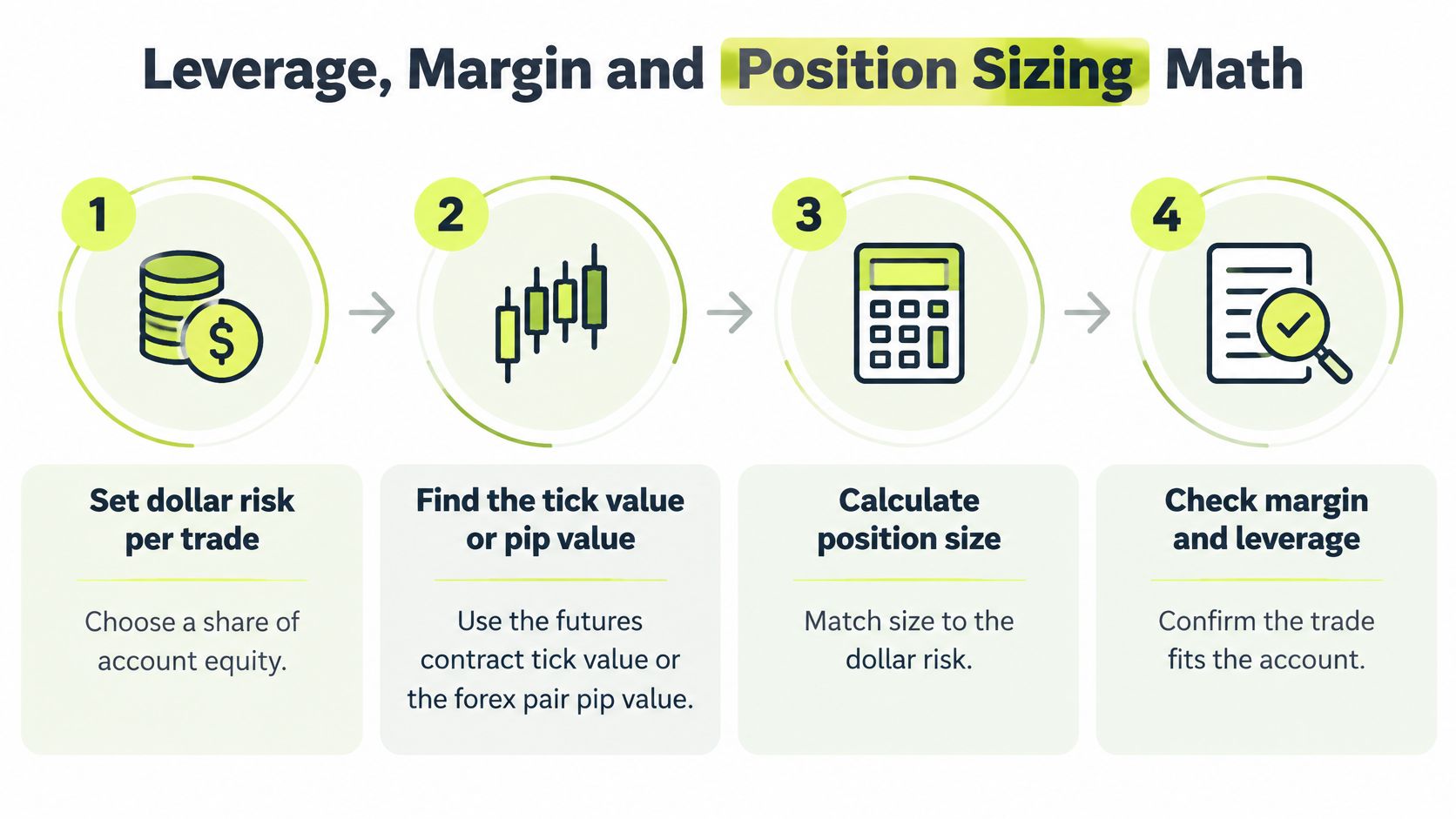
Five steps that set the quantity
- Set dollar risk as a share of account equity before you look at the contract. On a $10,000 account, 1% is $100. That $100 is the loss you accept if the stop is hit, not a suggestion.
- Find the tick value on the futures contract, or the pip value on the forex pair, for one unit. A contract worth $12.50 per tick is a different instrument from a micro, even when the chart looks identical.
- Divide dollar risk by stop distance times tick or pip value. A 10-tick stop at $12.50 is $125 of risk per full contract. $100 divided by $125 is 0.8 contracts. You cannot trade 0.8 of a full-size future, so the full contract already exceeds the budget. Use a smaller contract or a tighter stop, and only if the tighter stop still sits beyond normal noise. The same division on forex often yields a fractional lot the broker will accept.
- Add expected slippage, commissions, and overnight roll or financing to the stop loss before you call the trade sized. If two ticks of slippage are normal at your size, the true risk is wider than the chart stop. Pair this with a written rule for how to determine stop loss and take profit so the exit is not a guess made after the fill.
- Check the margin for that quantity and keep reserve cash. Futures traders need buffer for intraday mark-to-market losses and for margin increases. Forex traders should stress-test the broker's liquidation threshold and the rollover charge, because a margin percentage can change while the position is open.
Why the leverage label misleads
Two accounts can show similar position size and very different ruin paths. One posts a performance bond calibrated to cover most anticipated moves over the liquidation window, then still loses more than that bond if the move is in the tail the model did not cover. The other posts a small forex margin percentage and can be closed by the broker long before the chart stop, or held through a financing charge the backtest ignored.
For automation, encode the instrument's tick or pip value, the margin assumption, the session, and the expiration or roll behavior. A currency signal is not a fungible market order. Treat duplicate alerts as a sizing error: two fills double the risk you just calculated.
Size from the dollars at the stop, not from the margin a venue offers.
Which Market Fits Your Situation
Most futures-versus-forex writeups compare features and skip the risk you are trying to control: loss probability, gap and liquidity risk, misuse of borrowed capital, or operational failure.
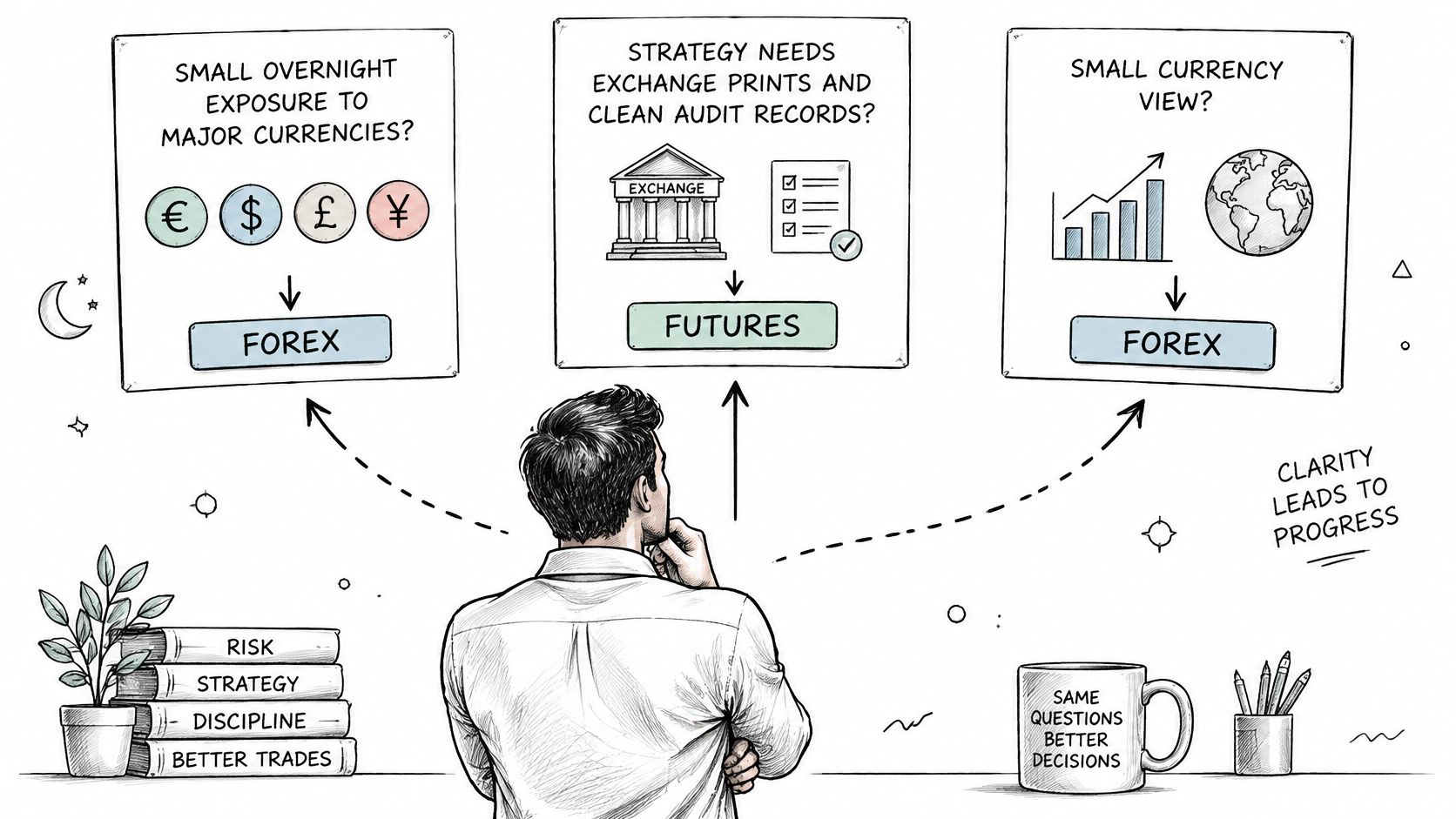
| Trader situation | Better fit | Why |
|---|---|---|
| Small exposure to major currencies held overnight | Spot forex | Continuous spot exposure with no expiry to manage |
| Strategy needs exchange prints and clean audit records | Futures | Centralized prices and standardized contract sizing |
| Small currency view with fixed contract size | Micro currency futures | Reduced size, but expiry and rolling must be managed |
| Backtest built only on midpoint prices | Neither until retested | Needs bid, ask and roll-adjusted data before the result means anything |
| Limited capital tempted by high leverage | Either, at smaller size | Leverage is a choice; size from the money at risk |
Why the row, not the brand
Overnight majors with a small line fit spot because you are not scheduling a roll every few weeks. You still pay financing, and you still accept that the quote is the dealer's.
If the strategy's edge depends on proving the fill, futures fit better. One order book, published volume, and a contract size that does not change between brokers give you an audit record you can match to the alert. That matters when you later ask whether the live trade was the backtest trade.
A small currency view with a fixed unit size fits micro currency futures. You get a smaller notional than the standard contract. You do not escape expiration. Put the roll on the calendar or the position expires out from under the signal.
A midpoint backtest fits neither market yet. Midpoint or bar-close data skips the spread you pay and the roll you will trade. Until the test uses bid, ask, and roll-adjusted prices, the profit number is a chart result, not an execution result.
Limited capital attracted by high borrowing capacity suits either market only at a smaller size. The offered ratio is a ceiling, not a target. If the dollar risk at the stop does not fit the account, the trade does not fit, whatever the product page says.
A risk budget, not a safer badge
Regulation does not make futures automatically safer. Summaries of retail forex disclosures, collected by Enlightened Stock Trading, show that international regulatory samples commonly report 63%–89% of retail forex and CFD accounts losing money. Futures fail differently. Exchange margin is not your maximum tolerable loss, and a fast move can lose more than the initial deposit.
Build the budget in five lines: loss per tick, overnight and news-event exposure, liquidation distance, maximum order size, and what a duplicate or delayed automated order does to that size. Market risk and automation risk are separate. Neither a rulebook nor a central match engine stops a malformed alert, a stale signal, a wrong contract size, or a live connection nobody is watching. Loss-rate summaries do not show that one asset class is safer.
Tax treatment of gains and losses differs by jurisdiction and by market. Check that with a tax adviser before you pick a venue. The fit is whichever risk you are trying to control, not a default winner.
Testing a Strategy Before Either Market Goes Live
A backtest is a test of past behavior, not a forecast. The failure mode that matters in futures vs forex trading is a result that used the wrong price, then met a live book.
Neutral descriptions of the two structures, including broker comparison pages such as Plus500's futures and forex overview, separate decentralized OTC spot from exchange-traded contracts with centralized clearing, visible pricing, and a roll you must operate. That split is exactly what a test has to model.
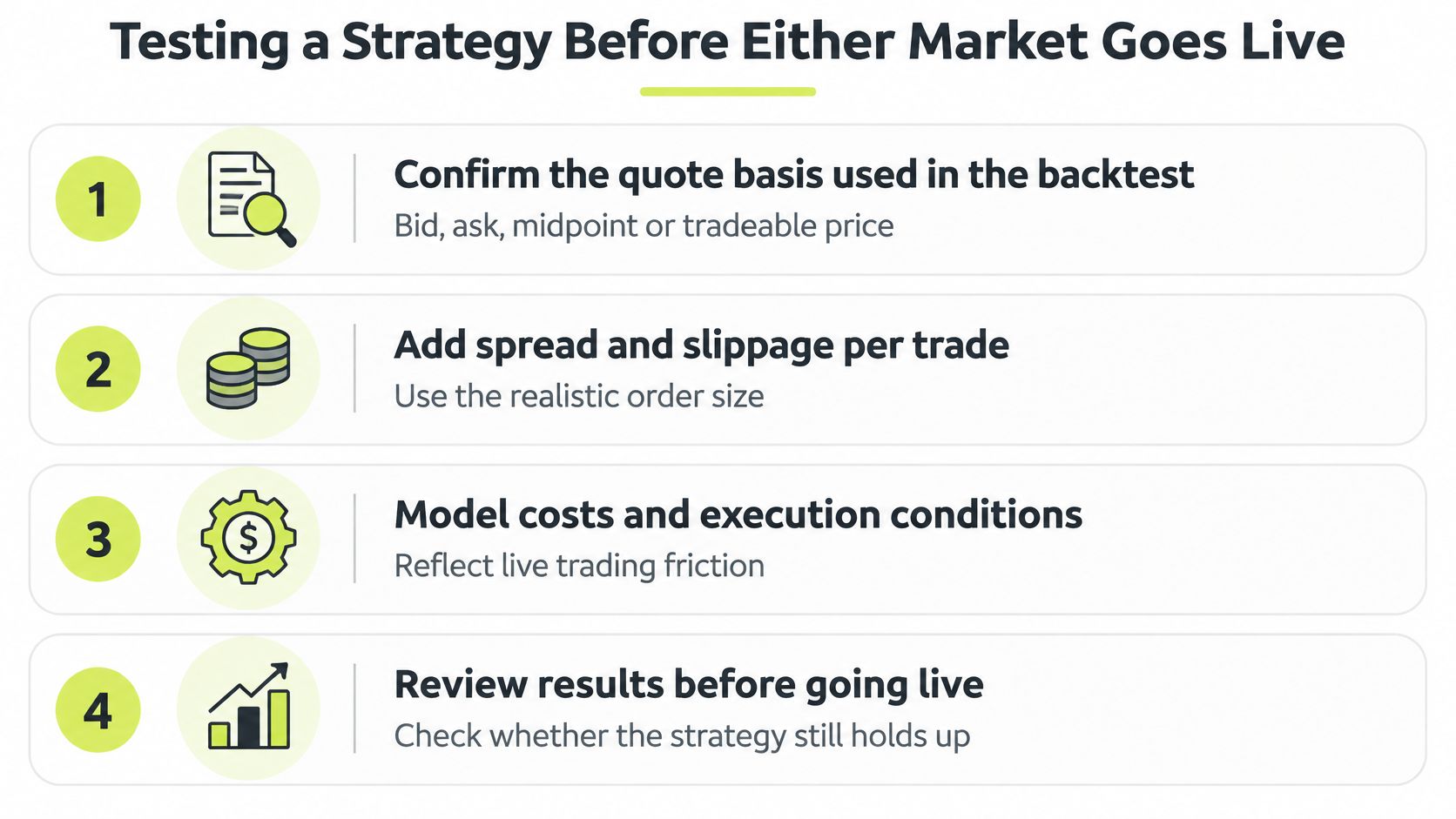
Run this sequence
- Confirm the quote basis in the backtest: bid, ask, midpoint, or a tradeable price. A midpoint series can show a profit that disappears once you buy the ask and sell the bid. If you only have bar closes, you do not yet know the fill.
- Add spread and slippage on every trade at the realistic order size. One pip on a major and one tick on a liquid future are not the same cost once the strategy trades all day. A guide to how to backtest a trading strategy should force that friction in before you trust the curve.
- Model contract rolls for futures and rollover charges for forex. A roll that changes the symbol mid-trade is a new order, not a continuation. Nightly financing on a three-week spot hold is a cost the chart does not print.
- Check session hours and drop the thin periods the strategy would still try to trade. Weekend opens, the maintenance break, and news seconds are where slippage stops being average.
- Run in test mode. Alerts are accepted and logged but never sent to the broker until you switch to live. Pineflows starts that way on purpose.
- Review the alert log and match each event to the chart bar it came from. A late alert on the next bar is a different trade from the one you tested.
- Check duplicate alerts, delayed alerts, and a paused state before any live switch. Two copies of one signal double the size. A pause that still fires entries is not a pause.
The short checklist
- Quote source: Name the feed, not "the chart."
- Spread model: Bid-ask by session, not a single average.
- Slippage assumption: Ticks or pips at your size.
- Margin method: Performance bond or broker percentage, plus a raise.
- Rollover treatment: Futures roll and basis, or nightly forex financing.
- Order-status reconciliation: Each alert tied to a logged status, not a hope that it arrived.
You have to watch the automation. Alerts can arrive late, twice, or not at all. Markets move. Brokers reject orders. Software is not investment advice, trading involves risk of loss, and a backtest is not a forecast. Passing the seven steps means the log matches the chart. It does not mean the next month will match the past.
Confirm the Market and Test Mode Before Live Trading
Three checks decide whether you leave research and send orders.
- Pick the situation row that matches you: overnight spot, exchange audit trail, micro contracts with a roll, a midpoint test that is not ready, or a small account that must trade smaller.
- Set the loss per trade from dollars at the stop, using tick or pip value, then add slippage, commission, and financing. If the full contract does not fit, do not take it.
- Demand a test-mode log that matches the chart bar by bar, including duplicates, delays, and a working pause, with entries handled separately from protective exits.
We place market orders only, for US equities and ETFs. Futures and forex strategies fall outside what we execute. An equity or ETF strategy built from TradingView alerts is the match. If your strategy trades futures or forex, use the checks above to choose a broker or platform outside this pipeline.
Test mode is the default. Alerts are logged and no orders go out until you switch to live. A 7-day free trial starts when onboarding finishes, with no card needed. Confirm test mode is on, review the first alert log against the chart, and go live only after the log matches what the strategy should have done.
A backtest remains a test of past behavior, not a forecast. Trading involves risk of loss.
Pineflows turns TradingView alerts into Robinhood market orders for US equities and ETFs, with a test-first log so you can see the fill path before any live order. That pipeline is built for equity signals, not for futures or forex tickets, which is why the execution checks in this article belong with the broker that holds those markets. Visit Pineflows to run the first alerts in test mode and compare the log with the chart before you switch anything live.